




How to Choose a Fanless Embedded PC

A fanless system that seems ideal on paper can still fail in real-world conditions if the thermal design, I/O mix, or power range does not fit the application. For teams in industrial automation, OEMs, healthcare integrators, and edge computing buyers, basic compute performance is only part of the story. Performance under extreme temperatures, strict ventilation conditions, and vibration thresholds all matter just as much.
A fanless embedded PC often gets used in applications where downtime is costly, service access is limited, and the replacement cycle is lengthy. That changes the focus of what matters most.
Choose like a system owner, not a desktop buyer.
How to Choose Fanless Embedded PC
Hardware Based on Application
The first step is to consider the application itself. A factory HMI controller, a vision inspection node, a medical cart workstation, and a transportation gateway might all need fanless operation, but they do not require the same platform.
Define what the system needs to do continuously, not just during peak scenarios. If the PC will run SCADA software, protocol conversion, and light data logging, a lower-power processor could be the better choice. It simplifies thermal management and lowers energy draw. If the unit must manage machine vision, edge AI tasks, or multiple high-resolution displays, the CPU and GPU requirements increase significantly, which impacts chassis design, heat dissipation, and mounting options.
This is where many projects go off track. Buyers often specify a higher CPU class while underestimating everything else. In embedded settings, the right choice pairs enough computing capacity for the workload with the environmental and connectivity features needed for reliable long-term operation.
Match Component Class
to Actual Workload
Processor selection should relate to software behavior, not just branding. The current generation Intel or AMD embedded processor may provide the performance needed for analytics, control, or visualization. However, each performance upgrade generally adds thermal load and may limit enclosure options.
For control applications, low to midrange processors are often adequate and can improve long-term stability in sealed installations.

For edge AI, multicamera inspection, or more intensive image processing, higher core counts and integrated graphics acceleration might require a larger thermal envelope.
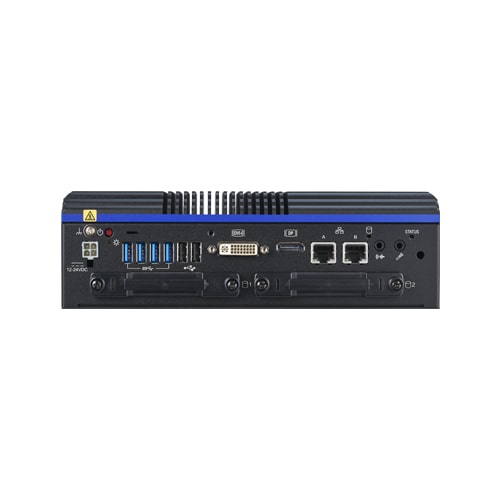
The tradeoff is clear: more computing power can resolve performance issues but may also lead to heat problems if the enclosure and ambient temperature are not considered early on.
Memory and storage are equally important. If the application uses containerized services, local databases, or image buffering, ensure there is enough RAM and choose industrial-grade SSD storage rated for endurance and temperature. In a 24/7 deployment, storage reliability is essential for system uptime.
Evaluate Thermal Design,
Not Just Fanless Labeling
Not all fanless systems are built for the same operating conditions. Some are intended for office-adjacent environments with controlled temperatures. Others are designed for factory floors, mobile equipment, or outdoor cabinets, where heat buildup is common.
Check the specified operating temperature range under realistic load conditions. A broad temperature rating is beneficial, but verify whether that rating changes based on processor type, storage options, or airflow around the chassis. Fanless performance relies on heat being transferred through the enclosure and dissipated into the environment. If the PC is placed inside a sealed cabinet next to drives or power supplies, the cabinet temperature may be significantly higher than the room temperature.
Surface design also matters. Extruded aluminum heat sinks, ribbed chassis construction, and vertical mounting designs are not cosmetic. They play a crucial role in thermal management. If the system is installed in a high-heat enclosure, choosing a lower TDP platform with proven thermal stability may be wiser than a faster unit operating at the edge of its limits.
Contec Americas can test PCs at application workloads in a thermal chamber that simulates real operating temperatures, so thermal behavior is verified against the deployment rather than assumed from a datasheet.
I/O Should Match
the Surrounding Equipment
The best fanless embedded PC integrates smoothly with the entire system. That means evaluating interfaces before finalizing the processor choice.
Industrial applications often need a mix of legacy and modern connectivity. Serial ports are still common for PLCs, barcode readers, instrumentation, and machine interfaces. Dual or multiple LAN ports might be necessary for network segmentation, protocol isolation, or firewall setups. USB is useful but should not be the only option considered if the application relies on reliable communication or compatibility with field devices.
Display outputs should match the application too. Digital signage, operator panels, and diagnostic workstations may require support for dual displays, while embedded controllers might not need any display output after commissioning. In vision and edge analytics scenarios, give attention to camera interfaces, bandwidth allocation, and storage write speeds.
Support for PCIe expansion, M.2 slots, wireless options, and isolated I/O could be essential depending on the deployment. In industrial and healthcare environments, how well the interfaces fit often determines whether a platform integrates smoothly or leads to engineering challenges.
Power Input and Mounting
Are Key Deployment Factors
Embedded PCs are often placed where standard AC desktop requirements do not apply. Many systems operate on 9 to 36 VDC, 12 to 24 VDC, or other wide-range DC inputs because control panels, vehicles, medical carts, and edge cabinets have specific power needs.
That is why reviewing power tolerance early is important. Look for the input range, ignition control if applicable, surge tolerance, and how well the power connector stays in place. A fanless unit might be technically compatible but underperform if its power design is too limited for field conditions.
Mounting style also impacts long-term reliability. DIN rail, VESA, wall mount, and panel mount options alter cable routing, service access, and thermal orientation. A compact chassis is inviting, but not if the connectors become unreachable once installed or if the heat sink fins are blocked.
Plan for Lifecycle,
Serviceability, and Validation
In B2B deployments, a fanless embedded PC usually is not a one-time purchase. It becomes part of a product line, a standardized panel design, or a validated infrastructure. That makes support throughout its lifecycle a significant selection factor.
-
Lifecycle availability: A shorter commercial product cycle can create pressure to redesign before the field deployment reaches its end. Embedded and industrial platforms are favored because they offer longer availability, better revision control, and more predictable support. For OEMs and integrators, this continuity reduces the complexity of recertifying, qualifying, and managing spare parts.
-
Serviceability: If storage, memory, or wireless modules may require updates, check their accessibility. If the unit is meant for controlled environments, confirm whether field servicing is permitted or whether a sealed, fixed configuration is the smarter option.
-
Validation: Validation should involve more than boot testing. Verify thermal performance under load, confirm I/O interoperability with actual field devices, and test startup and shutdown behavior under real power conditions. A well-specified platform still needs application-level validation.
Consider Environment
Specific Requirements
Dust, oil mist, washdown areas, vibration, shock, and electromagnetic noise all impact what qualifies as an appropriate system. In healthcare, cleaning, display compatibility, and peripheral support may take precedence over industrial cabinet concerns. In transportation or mobile setups, tolerance to shock and power fluctuations can outweigh raw computing performance.
This is where purpose-built products have an edge over general-purpose mini PCs. Industrial hardware is typically designed for greater resilience against environmental factors, a wider operational temperature range, stable I/O retention, and long-term deployment. For buyers comparing options, these factors often carry more weight than minor differences in benchmark scores. Contec Americas tailors its product range to real deployment variables such as DC input flexibility, operating temperature range, interface density, and expansion capabilities.
The Best Choice
Minimizes Field Risks
When deciding how to select a fanless embedded PC platform, focus less on being a desktop buyer and more on being a system owner. The right unit is not merely the fastest, smallest, or cheapest option. It is the one that aligns with the workload, endures the environment, connects with existing equipment, and stays maintainable throughout the deployment's life cycle.
This approach leads to better outcomes than chasing headline specifications. A fanless embedded PC should enhance installation stability, not complicate it. When the platform aligns with the application from thermal design to I/O to lifecycle planning, the system tends to stay productive instead of requiring troubleshooting.
For a deeper look at where hard requirements and minimum requirements diverge, see our guide on the difference between hard and minimum system requirements.
Talk to an Engineer About Your Fanless Deployment
Contec Americas helps OEMs, integrators, and procurement teams match fanless embedded PCs to real deployment variables: thermal design, I/O density, DC input range, and lifecycle availability. Bring us your application and we will help you specify a platform that stays productive in the field.
Talk to an Engineer